News
Duke-UNC ADRC Faculty Take the Global Stage at AAIC 2026
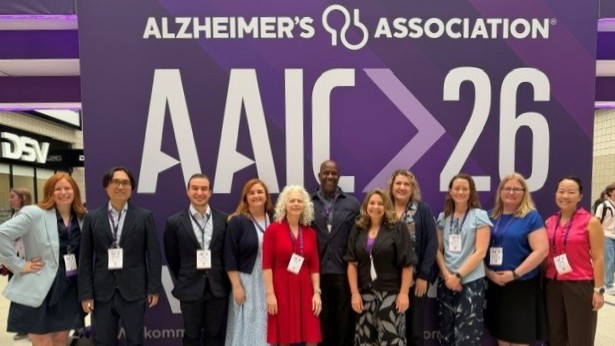
This July, the world’s dementia research community gathered in London for the Alzheimer’s Association International Conference (AAIC) 2026, and the Duke-UNC Alzheimer’s Disease Research Center was there in force, sharing new science, building collaborations, and helping set the agenda for the field’s next chapter.
AAIC is the Alzheimer’s Association’s flagship annual conference and one of the largest international gatherings dedicated to Alzheimer’s disease and related dementias. More than 13,000 researchers, clinicians, care professionals, advocates, and industry leaders convened in person and online this year, July 12-15, at ExCeL London. The conference brings together plenary sessions from leading scientists, interactive “ASK!” Q&A sessions on drug discovery and biomarkers, Featured Research Sessions spanning genetics and clinical trial design, and Clinical Toolbox and Perspectives sessions focused on real-world care delivery.
Each year, AAIC’s goals extend well beyond the laboratory. The conference is built to advance scientific discovery while translating that science into practical strategies for prevention, diagnosis, treatment, and care; to foster collaboration across disciplines and borders; and to elevate emerging issues in brain health, dementia risk reduction, caregiving, and equity, ensuring scientific progress reaches all communities affected by dementia.
Duke-UNC ADRC investigators, faculty, and trainees were well represented across this year’s program. Presenters included Odmaa Bayaraa, Cara McDermott, Ph.D., Darina Petrovsky, Ph.D., Nicole Scott-Hewitt, Ph.D., Jerry Wang, M.D., and Heather Whitson, M.D., alongside Center colleagues Andrea Bozoki, MD., Sandy Cobb, Ph.D., Andy Liu, M.D., Sara Patillo, MSHS, Michelle Sanfilippo, MPAS., Kathleen Welsh-Bohmer, Ph.D., and Robert W. Turner II, Ph.D., who also attended and contributed to the meeting.
Highlights include:
- Odmaa Bayaraa, who presented two posters: “Encodings of Identity,” part of the Beyond the Data: Poster and Reception Exhibition, and “Exome Enriched Single-nuclei Long-read Sequencing Reveals Cell-type-specific Isoform Changes During Alzheimer’s Disease,” in the Basic Science and Pathogenesis: Genetics session.
- Cara McDermott, Ph.D., presented “Disparities in Medication Use Among Medicare Beneficiaries with Dementia” within the Dementia Care Research and Psychosocial Factors track.
- Darina Petrovsky shared findings on “Testing of a Music-based Application Prototype to Improve Insomnia Symptoms in Persons Living with Dementia”.
- Nicole Scott-Hewitt, Ph.D., presented “RNA-Dependent Neuroimmune Condensates Link Complement C1q to Amyloid Pathology in Alzheimer’s Disease” in the Developing Topics: Basic Science and Pathogenesis session.
- Jerry Wang, M.D., neuropathology core lead, and Erin Connolly, research analyst for the Bryan Brain Bank, presented “TDP-43 and Tau Seed Amplification Assays for Late Diagnosis and Differentiation from AD” in the Biomarkers track.
- Heather Whitson, M.D., took part in “From Evidence to Practice: Implementing Alzheimer’s Association Clinical Guidance in Real World Care,” a session focused on translating research findings into everyday clinical practice.
Beyond the podium, the Duke-UNC ADRC’s Robert W. Turner II, Ph.D., continues to help lead national efforts to broaden who does, and who benefits from, Alzheimer’s research. He is part of the leadership team for ISTAART’s the Black Men’s Brain Health Emerging Scholars Program (ESP), which supports current and alumni scholars presenting at AAIC and works alongside Alzheimer’s Association leadership to expand mentorship and representation in brain health science.
Together, this breadth of participation, spanning basic science, genetics, biomarkers, dementia care, and health equity, reflects the Duke-UNC ADRC’s standing as a nationally recognized leader in Alzheimer’s disease and related dementia research, clinical translation, and community engagement.
AAIC 2026 reminds us why this work matters far beyond the conference halls. Every poster, panel, and conversation in London traces back to the Duke-UNC ADRC’s core mission: advancing the science of Alzheimer’s disease and related dementias, translating discoveries into better care, supporting families navigating a dementia diagnosis, and promoting brain health equitably across the diverse communities we serve. As our faculty returned home, they carry new ideas, new collaborations, and renewed momentum for the work ahead.
Drafted with assistance from AI and reviewed by the author.

